
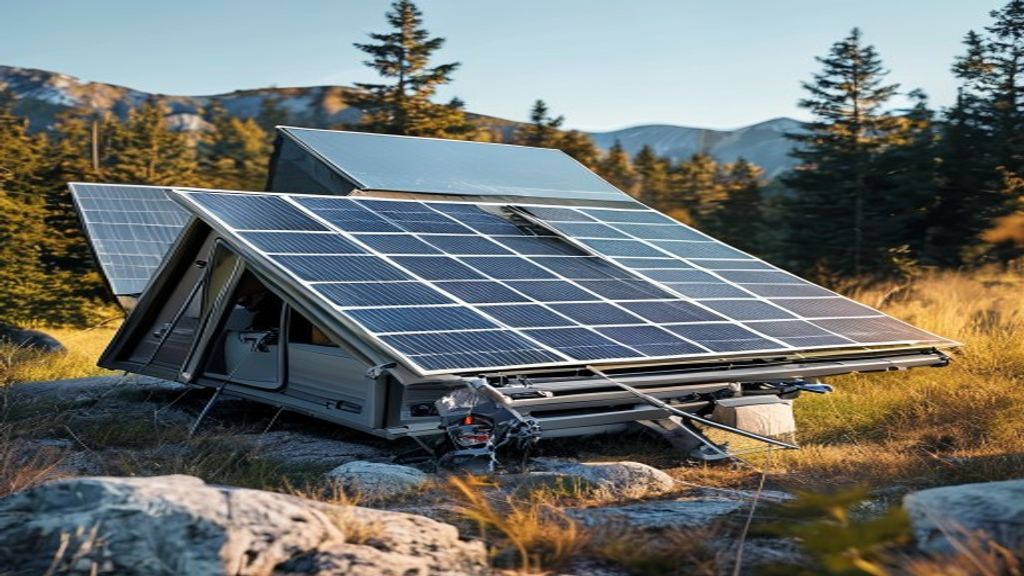
The best solar panels for camping in 2026 are the ones with the smallest gap between the number on the box and the number that actually reaches your battery. Based on aggregated owner reviews, manufacturer specification sheets, and independent published bench data, that gap is bigger than most shoppers expect.
If you’re shopping for the best solar panels for camping, the first thing to unlearn is the sticker wattage. A “100W” panel almost never puts out 100W in the field, and the size of the shortfall varies wildly by brand. That’s the entire story of this roundup: not which panel looks biggest on paper, but which one loses the least in translation.
We’re not going to pretend we ran these panels ourselves. SolarGenLab aggregates verified owner reviews, manufacturer specifications, and independent published bench data — chiefly from OutdoorGearLab, who put a wide field of 100W-class panels through direct-sun and cloudy-sky charging sessions and published the wattage and watt-hour numbers. Where that data exists, we use it. Where it doesn’t, we say so.
The Rated-vs-Measured Watt Gap (Why 100W Almost Never Means 100W)
Portable solar panels deliver roughly half their rated watts under real outdoor conditions. Across independently published tests, that range runs from about 30% to 51% of the number printed on the panel. A “100W” panel that hands you 48-51W in direct sun is actually having a good day.
OutdoorGearLab’s testing makes the spread obvious. The Jackery SolarSaga 100W measured 50.7W sustained in direct sun — 51% of rated, the best ratio in the group. The Goal Zero Nomad 100 measured just 30.3W — 30% of rated, the worst brand-name result on record. Same “100W” label. Nearly double the real difference.
That gap is why this roundup ranks panels on measured or reported output and documented owner experience, not on the number printed on the laminate. If you want the fuller context on how the batteries these panels feed actually perform, our portable power station roundup covers the same rated-vs-real problem from the other side of the cable.
Best Overall: Renogy 100W Foldable
Renogy’s foldable panel uses a hinged, rigid aluminum frame rather than the soft fabric-fold design most competitors use. OutdoorGearLab measured it at 49.7W in direct sun and 60.0 Wh over one hour of direct charging — the highest watt-hour figure of any 100W panel the outlet has tested. It also posted the best cloudy-weather number in the whole field, at 20.0 Wh indirect, scoring 9.5 out of 10 for indirect performance.
OutdoorGearLab named it a Top Pick as “Best Solar Panel for Vans and RVs,” and singled out its adjustable fold-out legs as the strongest and most confidence-inspiring in the group. It uses MC4, the open-standard connector, so it’s daisy-chainable and works with essentially any MC4-compatible power station.
| Spec | Value |
|---|---|
| Price | Listed around $200 at the time of writing |
| Rated wattage | 100W |
| Measured direct-sun output | 49.7W (OutdoorGearLab) |
| Measured 1-hour direct Wh | 60.0 Wh (OutdoorGearLab, best in test) |
| Weight | 21.2 lb (OutdoorGearLab measured) |
| Connector | MC4, open standard |
| IP rating | Not published — OutdoorGearLab calls it waterproof but no exact rating exists |
| Spec | The brand claims | The evidence shows |
|---|---|---|
| Rated wattage | 100W | OutdoorGearLab measured 49.7W direct — 50% of rated |
| Cloudy performance | Not specifically claimed | OutdoorGearLab measured 20.0 Wh indirect, best in test at 9.5/10 |
You can read more on Renogy’s own site, though the exact IP rating still isn’t published there either.
Best Value: Luvknit 100W Foldable
Listed around $160 at the time of writing, the Luvknit undercuts nearly everything else in this roundup — and still measured 48.3W in direct sun, 48% of rated, per OutdoorGearLab. That’s in the same output tier as panels costing $200 to $400.
OutdoorGearLab’s tester put it bluntly: “I’m amazed that this inexpensive panel is working better than panels that cost over twice as much.” It out-measured both the $399 EcoFlow 110W and the $400 Goal Zero Nomad 100. OutdoorGearLab named it their Best Value pick.
| Spec | Value |
|---|---|
| Price | Listed around $160 at the time of writing |
| Rated wattage | 100W |
| Measured direct-sun output | 48.3W (OutdoorGearLab), 48% of rated |
| Measured 1-hour direct Wh | 55.7 Wh (OutdoorGearLab) |
| Connector | Not published |
| IP rating | Not published |
| Spec | The brand claims | The evidence shows |
|---|---|---|
| Rated wattage | 100W | OutdoorGearLab measured 48.3W direct, 55.7 Wh over one hour |
Best Budget: BigBlue SolarPowa 100 ETFE
Listed around $200 at the time of writing, the SolarPowa 100 measured 48.0W direct sun per OutdoorGearLab — 48% of rated — and posted the second-best cloudy-weather score in the entire field, at 9.0 out of 10 with 19.1 Wh indirect. It uses MC4, so it’s daisy-chainable and works with any MC4 station.
It’s also the thinnest packed panel OutdoorGearLab measured, at 0.5 inches folded. The tradeoff: there’s no cable storage pouch, so the cord rattles loose in your pack.
| Spec | Value |
|---|---|
| Price | Listed around $200 at the time of writing |
| Measured direct-sun output | 48.0W (OutdoorGearLab), 48% of rated |
| Measured indirect Wh | 19.1 Wh, 9.0/10 cloudy score (OutdoorGearLab) |
| Weight | 8.8 lb |
| Connector | MC4, open standard |
| IP rating | Not published |
| Spec | The brand claims | The evidence shows |
|---|---|---|
| Rated wattage | 100W | OutdoorGearLab measured 48.0W direct, 49.6 Wh over one hour |
Best for Jackery Owners: Jackery SolarSaga 100W
Listed around $199 on sale (regular $299) at the time of writing, the SolarSaga posted the best rated-vs-measured ratio of any panel OutdoorGearLab has tested: 50.7W sustained in direct sun, 51% of its 100W rating. Its one-hour direct figure of 57.4 Wh is close behind Renogy’s category-leading number.
OutdoorGearLab gave it their Editors’ Choice award, with tester Sam Schild calling it “impressive in almost every regard.” Fold-out legs make it quick to set up. The catch is the proprietary DC8020 connector — it needs an adapter to work with anything outside the Jackery Explorer line, and there’s no daisy-chaining. Jackery’s own FAQ also walks back the IP68 marketing claim, telling owners to avoid heavy rain or submersion. The 2025 redesign removed the cable storage pouch entirely.
| Spec | Value |
|---|---|
| Price | Listed around $199 sale (reg $299) at the time of writing |
| Measured direct-sun output | 50.7W (OutdoorGearLab), 51% of rated |
| Measured 1-hour direct Wh | 57.4 Wh (OutdoorGearLab) |
| Measured 1-hour indirect Wh | 17.4 Wh (OutdoorGearLab) |
| Weight | 7.9 lb (OutdoorGearLab measured) |
| Connector | Proprietary DC8020 (adapter to DC7909 included) |
| Spec | The brand claims | The evidence shows |
|---|---|---|
| Rated wattage | 100W | OutdoorGearLab measured 50.7W direct — best rated-vs-real ratio tested, but still a ~49% shortfall |
| Weather resistance | IP68 marketed | Jackery’s own FAQ says to avoid heavy rain or submersion — a walked-back claim |
Owners of the newer Jackery stations may want to check our Jackery Explorer 2000 v2 comparison before pairing panels, since solar input ceilings vary by model.
Best Adjustable Angle: Bluetti SP100L
Listed around $299 at the time of writing, the SP100L measured 48.0W direct sun per OutdoorGearLab — 48% of rated, in line with the BigBlue and Luvknit panels that cost less. What sets it apart is the legwork, literally: OutdoorGearLab praised its “very adjustable kickstand legs to get the ideal angle throughout the day.”
It also includes a cable storage pouch, though the hardwired cable itself sits outside it rather than tucked away. At $299, it’s a premium price for output that two cheaper panels already match.
| Spec | Value |
|---|---|
| Price | Listed around $299 at the time of writing |
| Measured direct-sun output | 48.0W (OutdoorGearLab), 48% of rated |
| Measured 1-hour direct Wh | 56.6 Wh (OutdoorGearLab) |
| Weight | 10.9 lb (OutdoorGearLab measured) |
| Connector | MC4, open standard |
| IP rating | Not published |
| Spec | The brand claims | The evidence shows |
|---|---|---|
| Rated wattage | 100W | OutdoorGearLab measured 48.0W direct, 56.6 Wh over one hour |
See Bluetti’s product page for the full spec sheet, though the IP rating remains unpublished there too.
Best High-Wattage Panel: EcoFlow NextGen 220W Bifacial
Listed around $279 on sale (a “regular” price of $649 that’s discounted so consistently it functions as a marketing anchor rather than a real price) at the time of writing, the NextGen 220W is the first portable panel to use N-type TOPCon monocrystalline cells, paired with tempered glass and ETFE lamination.
It ships with a genuine integrated 30-60 degree adjustable bracket and a printed angle guide — a real upgrade over EcoFlow’s own 110W panel, which OutdoorGearLab panned for using its zippered carry case as a stand instead of a real kickstand. Despite EcoFlow branding, the panel itself uses standard PV (MC4-type) connectors underneath, so it isn’t locked to one ecosystem the way the SolarSaga or Nomad lines are.
No credible instrumented test of this panel exists yet at this size. Given that the category median for 100W-class panels runs around 48% of rated output, a buyer should budget for roughly 105W real-world from a 220W-rated panel, not 220W. The US warranty is only 12 months — half of Anker’s — and that “$649 regular price” isn’t a price anyone has actually paid in volume.
| Spec | Value |
|---|---|
| Price | Listed around $279 sale (reg $649) at the time of writing |
| Rated wattage | 220W front / 175W rear (bifacial) |
| Measured output | Not published — no instrumented test exists at this size |
| Cell type | N-type TOPCon monocrystalline |
| Weight | 15.4 lb |
| Weather rating | IP68 (whole panel, per EcoFlow) |
| Warranty | 12 months (US) |
| Spec | The brand claims | The evidence shows |
|---|---|---|
| Rated wattage | 220W front | No independent test published; category median is ~48% of rated, implying roughly 105W realistic output |
| “Regular” price | $649 | Sold at $279 on a near-permanent basis — the anchor price isn’t a functioning market price |
Panels to Avoid and Why (Proprietary Ports, Worst Measured Output)
Three panels in this category carry documented red flags severe enough that we can’t recommend them, even at their list prices.
The Goal Zero Nomad 100 measured just 30.3W direct sun per OutdoorGearLab — 30% of rated, the worst-performing brand-name panel the outlet has tested. OutdoorGearLab’s own summary: “Not very efficient, heavier than most.” At a $400 list price for 30 measured watts, a $160 Luvknit that measures 48W is a better buy on every axis. It also uses Goal Zero’s proprietary 8mm/HPP connector, the worst lock-in in the category — it needs a Goal Zero-specific cable even to move between Goal Zero’s own products.
The Goal Zero Boulder 100 Briefcase measured 40.3W direct — 40% of rated — but its cloudy-weather number is the real problem: just 5.6 Wh in an hour of indirect light, the worst of any 100W panel OutdoorGearLab tested, scoring 3.0 out of 10. At 25.9 lb it’s also the heaviest panel in the field. OutdoorGearLab’s verdict: “Bulky, seriously heavy.”
The EcoFlow 110W measured 38.3W direct — 35% of rated, OutdoorGearLab’s stated figure for “efficiency in direct sunlight” — the worst rated-vs-real gap of any name-brand panel in their test set. It also lacks a real kickstand; the zippered carry case doubles as a stand, which OutdoorGearLab called “less ideal” for that purpose. At $399 list for 38 measured watts, it’s the worst dollar-per-real-watt figure in the category.
The Anker SOLIX PS100 belongs in this conversation too. It measured only 38.7W direct — 39% of rated — with weak cloudy performance at 5.5 out of 10. OutdoorGearLab’s cons, verbatim: “Not the most efficient, expensive.”
Connector Compatibility: MC4 vs Proprietary Explained
MC4 is the open industry standard. Panels using MC4 — Renogy, BigBlue, Bluetti’s SP100L, and the underlying connector on EcoFlow’s NextGen 220W — can be daisy-chained and will plug into any power station built around the same standard, sometimes with a simple adapter cable.
Proprietary connectors lock you to one brand. Jackery’s DC8020, used on the SolarSaga line, requires an adapter even to reach Jackery’s own older DC7909 ports. Goal Zero’s 8mm/High Power Port is worse still — it can require a brand-specific adapter cable to move between two Goal Zero products. If you plan to upgrade your power station later or buy a second panel from a different brand, proprietary ports are the single biggest long-term cost trap in this category.
How to Match a Panel to Your Power Station’s Solar Input
Check your power station’s maximum solar input wattage before buying any panel. Pairing a 220W-rated panel with a station that only accepts 100W of solar input wastes the difference — the excess is simply never used.
Remember the real-world math: a 100W-rated panel typically delivers somewhere in the 30-51% range depending on the model, per OutdoorGearLab’s published figures. If your station can accept 200W of solar input, you may need two 100W panels in parallel, or a single higher-wattage panel, to approach that ceiling in real sun. Our guide to choosing a power station walks through matching solar input to battery capacity in more depth.
There is no lab here. We aggregate published independent bench tests, the manufacturer’s own spec sheets, and verified owner reviews — and when they disagree, we print the disagreement instead of hiding it. Read our full review process, or compare batteries in our Portable Power Station Honesty Index.
FAQ
How many watts of solar panel do I need for camping?
It depends on your power station’s battery capacity and how fast you need to recharge it, but most weekend campers do fine with a single 100W-rated panel — as long as you plan around its real output of roughly 40-51W in direct sun rather than the number on the box. If you’re running larger appliances or camping for extended stretches, a 200W-class panel or two paired 100W units gives more headroom.
Do camping solar panels really produce their rated wattage?
No. Every 100W-class panel with a published independent measurement falls short of its rating, with the documented range running from about 30% to 51% of rated output depending on the brand and model. The best solar panels for camping in this roundup are ranked specifically because of how small or large that shortfall is, not because of the sticker number.
Can I use any solar panel with my power station?
Only if the connectors match, or you have the right adapter. MC4 is an open standard that works across brands with the right cable. Proprietary connectors — Jackery’s DC8020 or Goal Zero’s 8mm/HPP port — lock you into that brand’s ecosystem unless you buy an adapter, and even then, daisy-chaining usually isn’t possible.
What is the difference between MC4 and proprietary solar connectors?
MC4 is an industry-standard connector used across many brands, including Renogy, BigBlue, and Bluetti’s SP100L, and it allows daisy-chaining multiple panels together. Proprietary connectors are brand-specific designs — Jackery’s DC8020 or Goal Zero’s HPP port — that require adapters to work outside their own ecosystem, and sometimes even within it.
Are bifacial solar panels worth it for camping?
The rear-side gain from bifacial panels depends entirely on ground reflectivity, or albedo. Reported gains range from roughly 5-8% on grass or dirt up to around 22% on a bright white ground sheet. Most campsites don’t offer a reflective surface, so the bifacial bonus on a panel like Jackery’s SolarSaga 200W or EcoFlow’s NextGen 220W is unlikely to deliver its best-case number in the field.
What size solar panel do I need to recharge a portable power station in a day?
Match your panel’s realistic output — not its rated wattage — against your station’s battery capacity in watt-hours, then divide by the hours of usable direct sun you expect. Since most 100W-rated panels only deliver 40-51W in direct sun per OutdoorGearLab’s published figures, plan on roughly half the rated wattage when estimating recharge time, and add a buffer for cloudy stretches.